Every nonprofit, charity and cause-driven organization faces the same fundamental challenge: reaching more people who care enough to give. Traditional fundraising methods, including direct mail, email appeals and gala events, can only take you so far. They rely on your existing audience, your current budget and your own team’s capacity to promote and execute.
Peer-to-peer fundraising changes the equation entirely.
Instead of your organization doing all the outreach, your existing supporters do it for you. They tell their friends, family and colleagues. They share your cause through their personal networks.
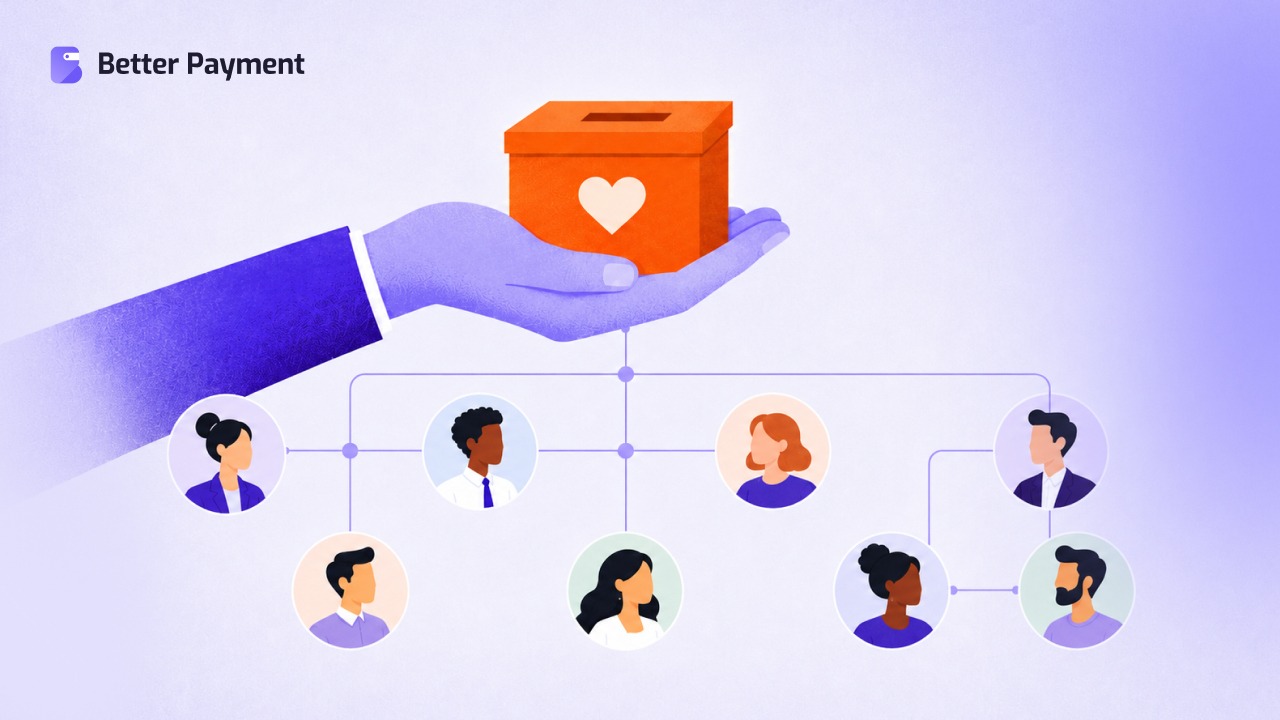
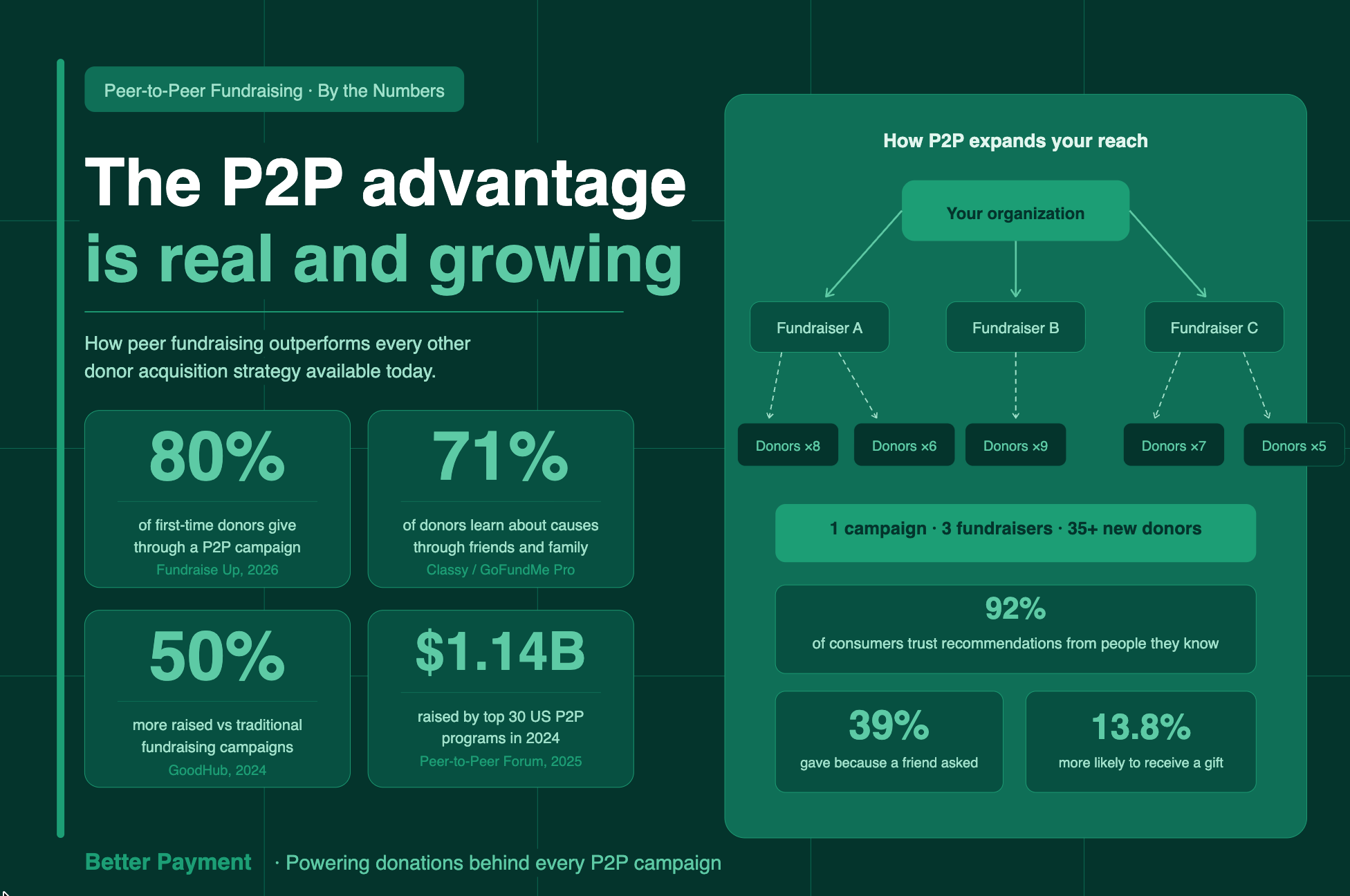
According to research, 71% of all donors learn about new causes and giving opportunities through friends and family. That single statistic explains why peer-to-peer fundraising consistently outperforms every other donor acquisition strategy available to nonprofits today.
This guide covers everything you need to know about peer-to-peer fundraising: what it is, why it works, what the data says, how to launch a successful campaign and one of the best peer-to-peer fundraising tools.
Quick Summary / TL;DR
Before launching a campaign, it helps to understand why peer-to-peer fundraising works so well and where organizations often miss opportunities. This quick summary breaks down the biggest insights, strategies and trends shaping successful P2P fundraising campaigns so you can reach more donors faster and build stronger long-term support.
| Key Takeaway | What You Need to Know |
| Peer-to-peer fundraising expands donor reach | Peer-to-peer fundraising helps nonprofits reach entirely new audiences by turning supporters into fundraisers who share your cause with friends, family and coworkers. |
| Trust drives more donations | Around 71% of donors discover new causes through people they know. Personal recommendations consistently outperform traditional fundraising appeals because people trust familiar connections. |
| P2P campaigns attract first-time donors | Most of the first-time donors come through P2P fundraising campaigns, making it one of the strongest donor acquisition strategies for nonprofits. |
| Personal stories convert better | Fundraisers who personalize their page with a personal connection to the cause typically raise more because authentic storytelling builds emotional trust. |
| Quality beats quantity in 2026 | Recruiting hundreds of fundraisers is not enough. Successful organizations focus on supporter onboarding, motivation and campaign guidance to help fundraisers perform better. |
| Mobile-friendly giving is essential | Since a large portion of nonprofit traffic comes from mobile devices, donation forms must be fast, simple and optimized for phones to avoid losing donors. |
| Matching gifts increase results | Promoting employer-matched donations can significantly boost total campaign revenue and encourage larger gifts from supporters. |
| Strong follow-up improves retention | First-time donors acquired through peer-to-peer fundraising are more likely to give again when nonprofits send personalized thank-you messages and ongoing updates. |
| Digital-first fundraising is growing | Online-first P2P fundraising campaigns are growing faster than traditional in-person events, making social sharing and digital storytelling more important than ever. |
| Donation experience impacts conversion | Even the best campaign can lose donors if checkout feels difficult. Simple, fast donation systems help nonprofits convert more supporter intent into completed donations. |
What Is Peer-to-Peer Fundraising?
Peer-to-peer fundraising, often abbreviated as P2P fundraising, is a model in which individual supporters create their own personal fundraising pages on behalf of your organization and solicit donations from their own networks of friends, family, coworkers and social media followers.
Each participant connects their individual page to your central campaign. Donations collected through those personal pages flow directly to your organization. The result is a distributed network of fundraisers, each working within their own community on your behalf, collectively reaching audiences that your organization could never access on its own.
This approach is fundamentally different from traditional crowdfunding, where your organization creates a single campaign page and drives all traffic toward it. In peer-to-peer fundraising, personalization becomes the key driver of donations. Supporters can share their own story and connection to your cause, making the ask feel more authentic and persuasive than a generic organizational appeal.
How Peer-to-Peer Fundraising Works: A Simple Example
Imagine your nonprofit is raising funds to build clean water systems in rural communities.
Instead of relying on one donation page, you invite 100 supporters to become fundraisers. Each supporter creates a personal page with a goal, such as raising $500. One supporter may share why access to clean water matters to them because of a volunteer experience. Another may dedicate their campaign to a loved one.
They then share their fundraising page across WhatsApp, Facebook, LinkedIn and email with people they personally know.
If each supporter raises even $500, your organization raises $50,000 while reaching hundreds or even thousands of new donors who may never have discovered your nonprofit otherwise.
This network effect is exactly why peer-to-peer fundraising often outperforms traditional fundraising methods in donor acquisition.
Real-Life Examples of Peer-to-Peer Fundraising Organizations
Many major nonprofits rely heavily on peer-to-peer fundraising to expand their reach and raise millions each year:
- American Cancer Society runs campaigns like Relay For Life, where supporters fundraise through personal pages and community events.
- St. Jude Children’s Research Hospital uses supporter-led fundraising events, fitness challenges and birthday fundraisers to drive donations.
- Charity: Water encourages supporters to launch birthday campaigns and personal fundraisers to help fund clean water projects globally.
- Movember Foundation built an entire movement around supporter participation, where individuals raise funds by running campaigns and sharing personal stories.
These organizations succeed because they turn supporters into advocates, multiplying fundraising reach far beyond what a single organizational campaign could achieve.
The Data Behind Peer-to-Peer Fundraising
The scale of P2P fundraising in the United States alone demonstrates how significant this model has become.
America’s largest peer-to-peer fundraising program is the Heart Walk, which raised $121 million for the American Heart Association, recording the largest year-over-year dollar increase with an $11 million gain.
Nonprofits responsible for America’s top 30 peer-to-peer fundraising programs increased fundraising revenue by 3% in 2024, with a total of $1.14 billion.
One number that should be in every nonprofit strategist’s toolkit: 80% of first-time donors to an organization give through a P2P campaign. This makes peer-to-peer fundraising arguably the most powerful donor acquisition tool available.
The average amount raised by peer-to-peer fundraisers is $244. While that may seem modest for an individual, multiply that figure across dozens or hundreds of active participants and the cumulative impact becomes substantial.
These numbers tell a consistent story: peer-to-peer fundraising reaches more donors, acquires first-time supporters and raises more money than comparable traditional digital fundraising campaigns.
Why Peer-to-Peer Fundraising Reaches More Donors Faster
Traditional fundraising relies on your organization to do all the outreach. Peer-to-peer fundraising works differently. It turns your supporters into advocates who share your mission through personal networks, helping you reach more people, build trust faster and attract donors your organization may never have reached on its own.
Here is why this model consistently drives stronger donor growth and faster campaign momentum:
1. It Operates on Trust, Not Advertising
The single most important reason P2P fundraising outperforms other models is trust. When a friend, family member, or colleague asks you to support a cause, you are far more likely to respond than when a brand or organization sends you an appeal.
Most of the consumers trust recommendations from people they know. Donors have direct access to friends, family members, coworkers and other peers who may have never heard of your organization. When current supporters vouch for your organization, they can more effectively make your case to new audiences.
Around 39% of Americans have donated to a cause because of a request made by a friend or family member. This is the trust advantage in action. No marketing budget can replicate the authenticity of a personal ask.
2. It Expands Your Reach Exponentially
Every new fundraising participant brings their own network of contacts to your campaign. Those contacts, in turn, may share the cause with their own networks. This creates a cascading reach that no single organization could achieve through direct outreach.
Each participant brings their cause to their friends, family and colleagues. That is a powerful way to increase your visibility with people who may never have encountered your organization otherwise.
3. It Builds Brand Awareness Beyond Donations
Those advocating and soliciting donations for your cause do more than just raise money on behalf of your organization. Their vocal, public support increases brand awareness for your mission. The maximum number of consumers who need to hear claims from a brand three to five times before they believe them. When peer-to-peer participants share fundraising materials with your organization’s logo, colors and imagery, they help reinforce brand recognition for your nonprofit.
4. It Creates Long-Term Donor Relationships
Donors who come through a peer-to-peer campaign often develop a deeper connection to your cause than those who respond to an impersonal appeal. Unlike one-time appeals, peer-to-peer fundraising builds deep, personal connections between your organization and its supporters. Successful P2P fundraisers often become long-lasting ambassadors for your cause and their personal appeals create a meaningful connection for new donors, making them more likely to give again in the future.
5. It Is Cost-Effective at Scale
Traditional fundraising campaigns can be resource-intensive, requiring significant time and money for outreach, events and promotions. With peer-to-peer fundraising, your fundraisers handle the bulk of the promotion and free up your team to focus on strategy, support and optimization.
Your organization provides the platform, the story and the tools. Your supporters provide the reach and the personal connections. This division of effort makes P2P fundraising one of the most cost-effective models for donor acquisition.
Types of Peer-to-Peer Fundraising Campaigns
Understanding the different formats of P2P campaigns helps you choose the one that is the right fit for your mission, your audience and your operational capacity.
Event-Based P2P Campaigns
The most established format, event-based campaigns ask participants to raise a minimum donation amount to participate in an event, such as a charity walk, run, bike ride, or swim. Participants create personal fundraising pages and solicit pledges from their networks before or during the event.
This format works well because the event itself creates natural urgency, a built-in social experience and a compelling story for fundraisers to share. The American Heart Association’s Heart Walk and the Breakthrough T1D Walk are examples of this model at its largest scale.
Challenge-Based P2P Campaigns
Challenge campaigns invite participants to complete a personal challenge, such as running a certain number of miles, reading a set number of books, or completing a fitness goal and ask their networks to donate in support of their effort.
In 2025 alone, supporters created over 80,000 challenge-style fundraisers, from yoga challenges and hikes to readathons and gaming events. This format is especially effective with younger donors who are motivated by personal achievement alongside social impact.
Giving Day Campaigns
A giving day is a concentrated fundraising period that only lasts 24 hours. The most well-known giving day is GivingTuesday. Your nonprofit can create a GivingTuesday campaign, as well as a unique giving day campaign on a date of your choice.
These campaigns create maximum urgency and work best when organized well in advance, with fundraisers recruited and briefed before the day itself.
DIY And Always-On Campaigns
DIY campaigns allow supporters to create personal fundraising pages at any time for any occasion: a birthday, a memorial, a personal milestone, or simply because they want to give back. This format requires less coordination but benefits from an ongoing presence and a streamlined process for participants to set up their pages.
Community fundraising expands beyond a single event by recognizing a simple truth: support does not only show up on event day. Community fundraising invites supporters to fundraise for your cause in ways that reflect their lives and values, such as birthdays, personal milestones, creative challenges, memorials and livestreams.
How to Launch a Successful Peer-to-Peer Fundraising Campaign
Launching a successful peer-to-peer fundraising campaign is not just about asking supporters to share your cause. It requires clear goals, the right participants, strong storytelling and a system that keeps fundraisers motivated from start to finish.
Follow these proven steps to build a campaign that reaches more donors, drives stronger engagement and raises more funds for your mission.
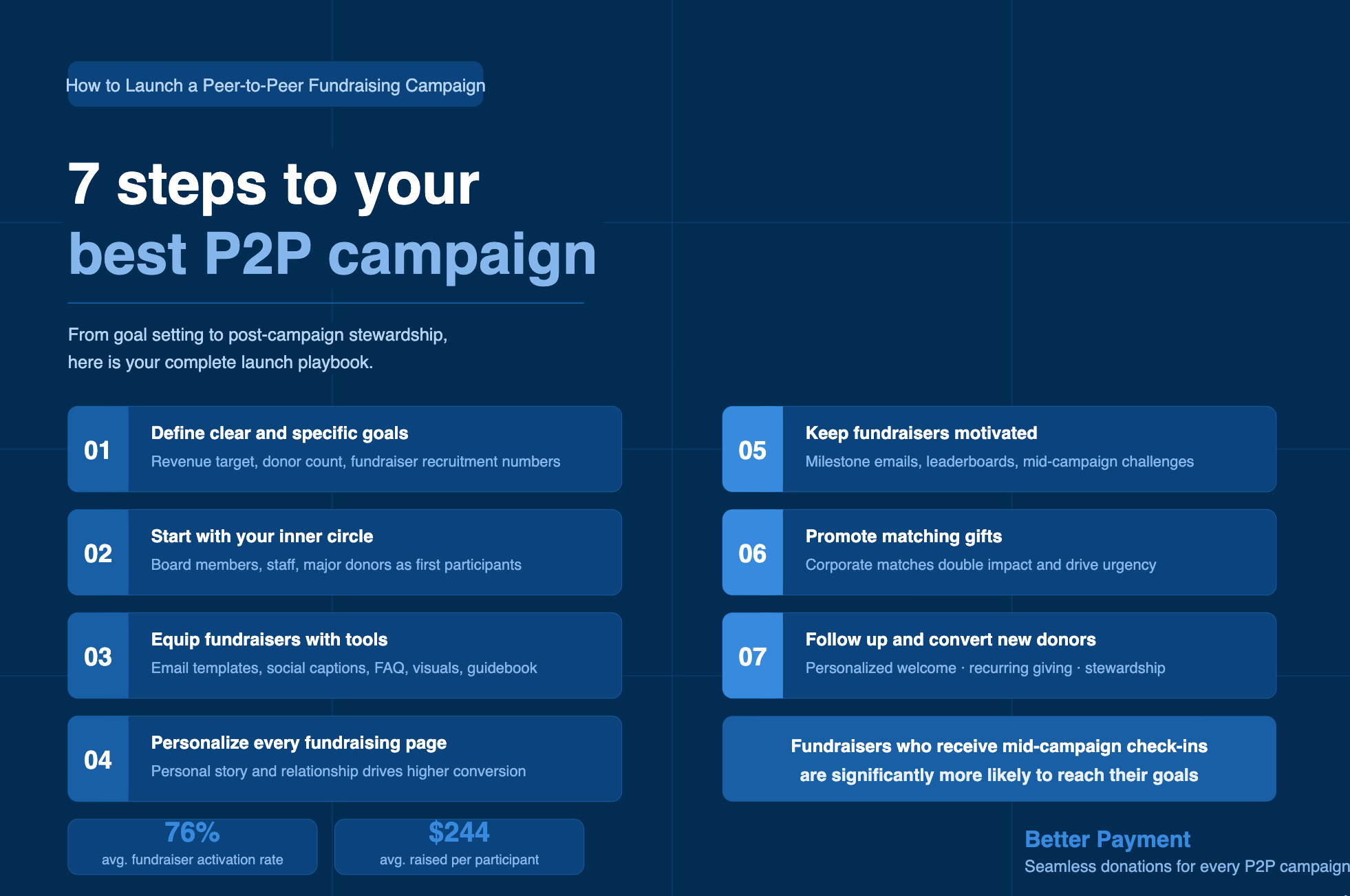
Step 1: Define Clear Goals Before You Begin
Along with a main revenue goal, consider other engagement targets such as new donor acquisition, event attendance and organic traffic to your nonprofit’s website. Since peer-to-peer fundraising campaigns are all about generating online engagement, setting these types of goals will give your strategy structure and boost overall impact.
Be specific. Instead of “raise more money,” define a goal such as: recruit 60 fundraisers, each raising a minimum of $300, for a total campaign target of $18,000, with at least 150 first-time donors acquired.
Step 2: Start with Your Inner Circle
Do not start with strangers. Start with the inner circle: the relatives, friends, staff and your top five major donors. Their participation serves as powerful social proof.
The first wave of participants creates momentum that makes it far easier to recruit subsequent participants. When new prospects see that staff members, board members and major donors are already fundraising, they are more likely to join.
Step 3: Equip Fundraisers with the Right Tools
Your fundraisers are not professional marketers. They need ready-made materials that make it easy to share your cause authentically and effectively.
Provide your participants with:
- Email templates that they can customize and send to their contacts
- Pre-written social media captions and suggested hashtags
- A short FAQ answering common questions donors might ask
- One or two compelling images or short videos that communicate the impact of a donation
- A fundraiser guidebook that covers how to set up their page, how to make the first ask and how to follow up
Fundraisers who receive strong onboarding materials complete their first ask faster and raise more.
Step 4: Personalize Every Fundraising Page
Ask your peer fundraisers to personalize their own pages with their stories, why they care about the cause, whom they are honoring, etc. These personal testimonials resonate strongly with donors who know the fundraiser. By weaving a narrative and using visuals that spark empathy, you forge a deeper connection with potential donors.
A fundraiser who writes “I am raising money for this shelter because I adopted my dog from them three years ago” will always outperform one who copies the generic page text your organization provided.
Step 5: Keep Fundraisers Motivated Throughout the Campaign
The biggest drop-off in P2P campaigns occurs in the middle weeks. Automated milestone emails, leaderboard updates and mid-campaign challenges sustain energy. Research shows fundraisers who receive mid-campaign check-ins are significantly more likely to reach their personal goals.
Weekly update emails that celebrate milestones, highlight top fundraisers and provide a fresh piece of content to share keep participants engaged when momentum would otherwise stall.
Step 6: Leverage Matching Gifts
By actively promoting matching opportunities, you are ensuring no money is left on the table. Even a handful of matched donations can boost your total substantially. If one donor gives $200 and their company matches at a one-to-one ratio, that is an extra $200. Some companies have special matching programs for employees who participate in charity events, meaning they might match both donations and volunteer hours.
Announce your matching partners early and promote them heavily. A “your donation will be doubled” message is one of the most reliable conversion drivers in fundraising.
Step 7: Follow Up And Convert New Donors
The campaign does not end when the fundraising period closes. Every new donor who gives through a peer-to-peer participant is a potential long-term supporter.
Sending personalized acknowledgements to first-time donors significantly improves the likelihood of a second gift. Over 80% of donors are more likely to give again if reached out to.
Segment your new donors, send them a personal welcome message and introduce them to your organization’s broader mission and programs. The relationships your fundraisers started are yours to continue.
Common Mistakes That Undermine P2P Campaigns
Even well-intentioned campaigns can underperform when common pitfalls are left unaddressed.
❌ Prioritizing quantity of fundraisers over quality of engagement. The 2025 data is unambiguous: campaign volume rose 18%, but dollars raised per participant fell 20%. More fundraisers do not automatically mean more revenue. Prioritize your most passionate and well-networked supporters over broad, untargeted recruitment.
❌ Abandoning fundraisers after recruitment. Signing people up is only the beginning. If participants do not receive support, guidance and encouragement after they join, they stall. Many peer-to-peer campaigns still rely on tactics like free merchandise or minimal onboarding, boosting sign-ups without setting fundraisers up to thrive.
❌ Setting a generic or unemotional goal. Fundraisers need a specific, tangible goal to rally around. “Help us raise $25,000 to provide 500 meals to families in need” is far more compelling than “support our general operating fund.”
❌ Neglecting mobile optimization. Mobile users made up 57% of nonprofit website traffic, which means a significant share of donors will encounter your campaign on a phone. If your donation form or fundraising page is difficult to use on mobile, you will lose those potential donors.
❌ Failing to follow up after the campaign ends. New donors acquired through P2P campaigns have low retention if they are not welcomed and cultivated. A strong post-campaign stewardship plan is as important as the campaign itself.
The Evolving Landscape of Peer-to-Peer Fundraising in 2026
The P2P fundraising landscape is maturing rapidly. Several important shifts are reshaping how organizations approach these campaigns.
Quality Over Quantity Is Now the Defining Standard
Peer-to-peer fundraising is growing but evolving towards quality over quantity. Campaign volume rose 18% with stable activation rates, but dollars raised per participant fell 20%. This shift reflects a maturing approach where success comes from deeper participant support rather than simply recruiting more fundraisers.
The organizations seeing the strongest results are investing heavily in participant experience: better onboarding, more personalized coaching, mid-campaign check-ins and milestone recognition.
Digital-First Campaigns Are Outpacing In-Person Events
Digital-first campaigns offer advantages in reach and accessibility that in-person events cannot match. A supporter in any city or country can participate, share and raise funds without logistical constraints.
Younger Donors Are Reshaping the Model
Younger donors, particularly Gen Z and Millennials, are increasingly inspired by impact creators, people who use their platforms to raise awareness and drive charitable donations. More than half of Gen Z say they trust impact creators to donate on their behalf, highlighting the growing role of social-driven philanthropy.
Gen Z is motivated by social causes and shaped by peer networks and digital culture. They tend to give through crowdfunding sites, social media drives, or mobile apps rather than traditional methods.
For organizations targeting younger donor segments, P2P fundraising aligned with social media and community-based storytelling is not just effective. It is the primary model through which this generation engages philanthropically.
Community-Based Fundraising Is Becoming a Year-Round Strategy
Traditional peer-to-peer campaigns often revolve around a single moment, like an in-person event. Community fundraising expands that model by recognizing a simple truth: support does not only show up on event day. It turns supporters into advocate-fundraisers, not just participants.
Organizations that treat P2P as an ongoing community engagement strategy rather than a one-time campaign event see stronger long-term results in both donor acquisition and donor retention.
Crowdfunding vs Peer-To-Peer Fundraising: Understanding the Difference
These two models are often confused, but they operate very differently and serve different strategic purposes.
| Aspect | Crowdfunding | Peer-to-Peer Fundraising |
| How It Works | Your organization creates and manages a single campaign page. | Individual supporters create their own fundraising pages linked to a central campaign. |
| Primary Focus | The organization’s story and mission take center stage. | The supporter’s personal story and relationships drive donations. |
| Traffic Source | Promotion directs donors to one main campaign page. | Supporters bring in donors through their own networks. |
| Main Donor Network | Existing audience and organization-owned channels. | New audiences reached through supporter communities. |
| Role of the Organization | Manage, promote and optimize one campaign. | Equip, guide and support individual fundraisers. |
| Donor Acquisition Potential | More effective for engaging existing supporters. | Stronger for acquiring new donors through personal connections. |
| Best Use Case | Raising a specific amount quickly for a project or campaign. | Expanding donor reach and building long-term supporter relationships. |
| Long-Term Impact | Primarily short-term fundraising focused. | Builds community engagement and recurring supporter networks. |
| Ideal Goal | Quick fundraising from an established audience. | Growing awareness, donor base and community involvement. |
Many organizations use both strategically, running a crowdfunding campaign for specific projects while maintaining an ongoing P2P presence for community fundraising and donor acquisition.
How Better Payment Supports Your Peer-to-Peer Fundraising Campaigns
Running a successful peer-to-peer fundraising campaign depends on one critical element that is often underestimated: the donation experience itself. You can recruit the most motivated fundraisers in your community, equip them with compelling stories and drive traffic to your campaign, but if the process of actually completing a donation is complicated, slow, or confusing, you will lose donors at the final step.
This is where Better Payment makes a meaningful difference.
Better Payment is a WordPress payment and fund management plugin designed to make online payments and donation collection simple, fast and fully customizable. Built for seamless integration with both Elementor and Gutenberg. It removes the technical friction from donation collection so that your organization can focus on the campaign strategy and your fundraisers can focus on the personal outreach that makes P2P so effective.
i. One-Click Donation Collection
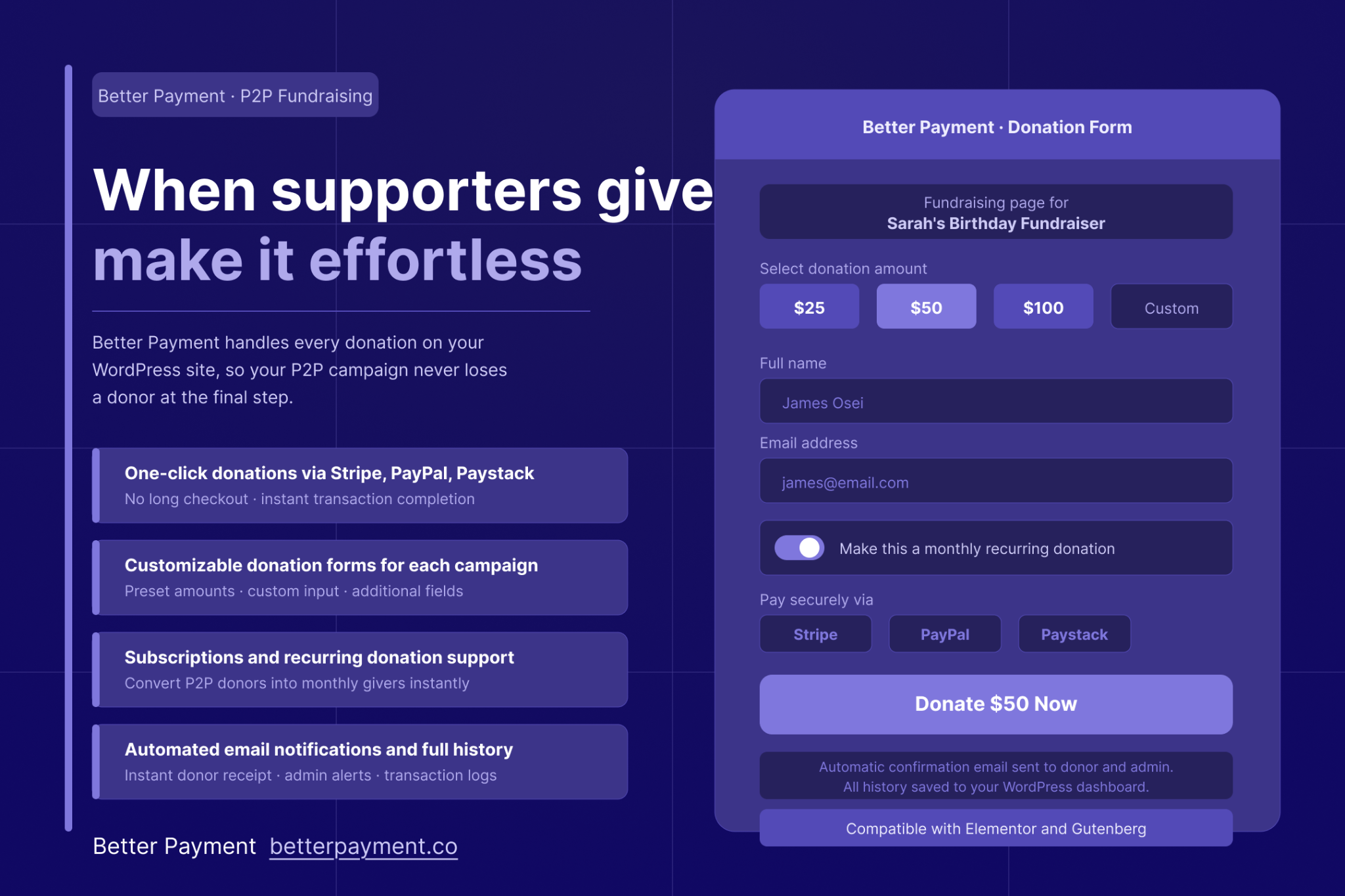
Better Payment enables one-click payment collection through Stripe, PayPal and Paystack. When a donor lands on a fundraising page and decides to give, they can complete their transaction without navigating through a complicated checkout process. In P2P fundraising, where many donors are first-time visitors to your organization’s digital presence, a frictionless experience is essential for conversion.
ii. Customizable Donation Forms for Every Campaign
Every P2P campaign is different. Better Payment’s powerful form builder allows you to create donation forms tailored to each specific campaign, with multiple preset donation amount buttons, a custom amount option and additional input fields for personalization.
Whether your campaign is a charity walk, a birthday fundraiser, or a giving day drive, you can build a donation form that matches the campaign’s tone, branding and specific fundraising goals.
iii. Flexible Payment Amount Options
Better Payment supports multiple donation amount buttons, giving donors the ability to choose from preset suggested amounts or enter their own. This is especially important in P2P fundraising, where donors may be motivated by a personal connection rather than a strategic giving decision. Giving them multiple clear options reduces hesitation and increases completion rates.
iv. Support for Subscriptions And Recurring Donations
Many donors who give for the first time through a peer-to-peer campaign are ideal candidates for recurring giving programs. Better Payment supports subscription payments, allowing your organization to offer donors the option to convert their one-time gift into a monthly recurring donation directly at the point of transaction.
v. Compatibility with Your Existing WordPress Setup
Better Payment is fully compatible with Elementor and Gutenberg, making it easy to embed donation forms anywhere on your website or campaign pages without custom development. Whether you are embedding a form in a sidebar, a landing page, or directly within a fundraiser’s individual campaign page, Better Payment integrates cleanly with your existing site structure.
For any nonprofit or cause-driven organization running peer-to-peer fundraising campaigns on a WordPress website, Better Payment provides the donation infrastructure that keeps the giving experience simple for donors and the management experience organized for your team.
Measuring the Success of Your P2P Fundraising Campaign
Knowing which metrics to track before, during and after your campaign is essential for continuous improvement.
Fundraiser Activation Rate
This is the percentage of recruited participants who actually create their fundraising page and solicit at least one donation. Activation rates remain strong and profile creation is steady, suggesting fundraisers are showing up, but not always equipped to succeed. If your activation rate is below this benchmark, your onboarding process needs strengthening.
Average Amount Raised Per Participant
Track how much each active fundraiser raises on average. This figure reveals whether your participant support strategy is working. At the campaign level, P2P campaigns typically raise twice as much as comparable traditional digital fundraising campaigns.
New Donor Acquisition Rate
Count the number of donors who gave through your P2P campaign but had no prior relationship with your organization. This is one of the clearest indicators of the campaign’s reach into new networks.
Donor Retention Rate
Track how many of the first-time donors acquired through the campaign give again within 12 months. This tells you whether your post-campaign stewardship is converting new contacts into long-term supporters.
Cost Per Dollar Raised
Calculate the total operational cost of running the campaign divided by the total funds raised. P2P fundraising typically delivers strong cost efficiency compared to traditional campaigns, but tracking this figure helps you allocate resources more effectively in future campaigns.
Social Sharing Rate
Track how often fundraising pages are shared on social media by both the fundraiser and their donors. Social sharing extends your campaign’s reach beyond direct participants and donors.
Building a Long-Term Peer-to-Peer Fundraising Strategy
A single peer-to-peer fundraising campaign can deliver strong results, but the most successful nonprofits do not treat P2P as a one-time event. They turn it into an ongoing strategy that consistently attracts new donors, strengthens supporter relationships and builds sustainable fundraising momentum over time.
To build a stronger long-term P2P fundraising strategy, focus on the following:
- Maintain an always-on fundraising presence
Give supporters the ability to create fundraising pages year-round, not just during major campaigns. Birthdays, memorials, personal milestones and community events can all become opportunities for donations. - Recognize and celebrate top fundraisers
Regularly spotlight high-performing supporters through emails, social media shoutouts, or campaign leaderboards. Recognition keeps fundraisers motivated and encourages repeat participation. - Turn every campaign into a recurring giving opportunity
Use each fundraising effort to introduce monthly donation programs. First-time donors acquired through peer-to-peer fundraising often become long-term supporters when nurtured properly. - Treat every new donor like the start of a relationship
Do not stop engagement after the first gift. Send personalized thank-you messages, share impact updates and introduce donors to your broader mission to improve retention. - Prioritize engagement over volume
Recruiting more fundraisers is not always the answer. Organizations seeing the best results invest in supporter onboarding, coaching and community-building to help participants succeed. - Combine community power with reliable donation tools
The strongest campaigns pair authentic supporter outreach with a frictionless donation experience. A fast, simple and professional payment process helps convert donor intent into completed contributions.
The future of peer-to-peer fundraising belongs to organizations that focus on deeper supporter relationships, stronger community engagement and systems that make fundraising easy for both participants and donors.
Your Supporters Are Your Greatest Fundraising Asset
The most powerful fundraising tool your organization has is not a software platform, a direct mail list, or a social media account. It is the people who already believe in your mission.
Peer-to-peer fundraising turns that belief into action. It gives your supporters a structure, a platform and a purpose. It connects your cause to networks of people who would never discover you through traditional outreach. And it does all of this at a fraction of the cost of conventional fundraising campaigns.
The data is clear. The model is proven. The tools are available. What remains is the decision to activate your community and put them to work for the cause they already care about.
And when those donors arrive ready to give, Better Payment ensures that the experience of completing that donation is as effortless as the decision to make it.
Ready to make every donation on your P2P campaign seamless and simple?
Better Payment is built for WordPress and designed to remove every obstacle between your donors and the impact they want to make.