Designing an effective buyer journey in 2026 requires more than defining funnel stages. Today’s buyers move across platforms, devices, and content formats before making a decision. They self-educate, compare alternatives independently, and validate choices through reviews, communities, and peer discussions.
If your business does not intentionally design this journey, you risk losing potential customers in the “messy middle.” This is the phase where buyers loop between evaluation and validation before deciding.
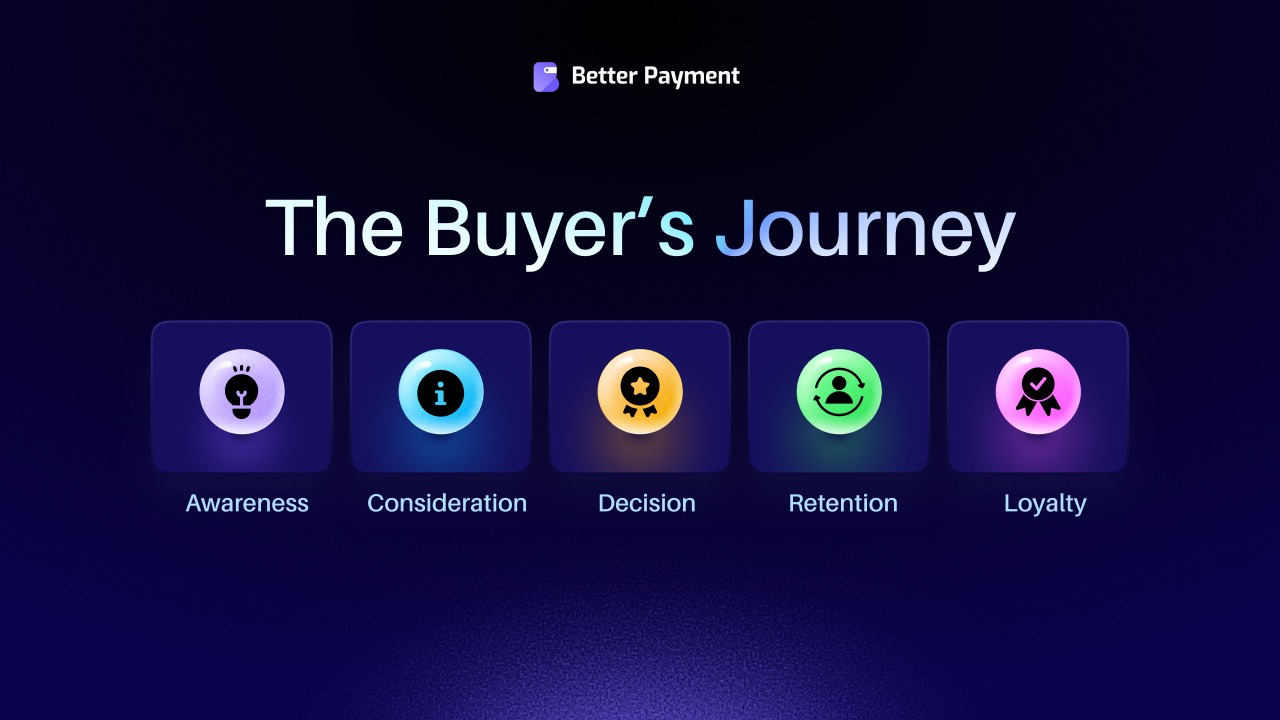
Understanding how to design a buyer journey means understanding human behavior, digital behavior, and decision psychology. This guide explores every layer of buyer journey mapping, combining structure with strategy so you can build a scalable customer experience strategy that converts and retains.
What Is a Buyer Journey?
The buyer journey refers to the complete customer purchase path from initial awareness of a problem to the moment a purchase decision is made. However, in Buyer Journey 2026, the concept goes beyond just pre-purchase behavior.
It is important to distinguish between:
- Buyer Journey: The stages leading up to the purchase decision.
- Customer Journey: The full lifecycle, including post-purchase retention and loyalty.
Many brands mistakenly focus only on acquisition. But an effective buyer journey considers how the purchase experience transitions into a long-term relationship. The sale is not the finish line; it is a milestone.
In practical terms, buyer journey mapping helps you answer three strategic questions:
- What triggers someone to start searching?
- What information influences their evaluation?
- What reduces hesitation before purchase?
When you can answer these clearly, your marketing funnel optimization becomes intentional rather than reactive.
The Modern Buyer Journey Stages (Expanded 2026 Model)
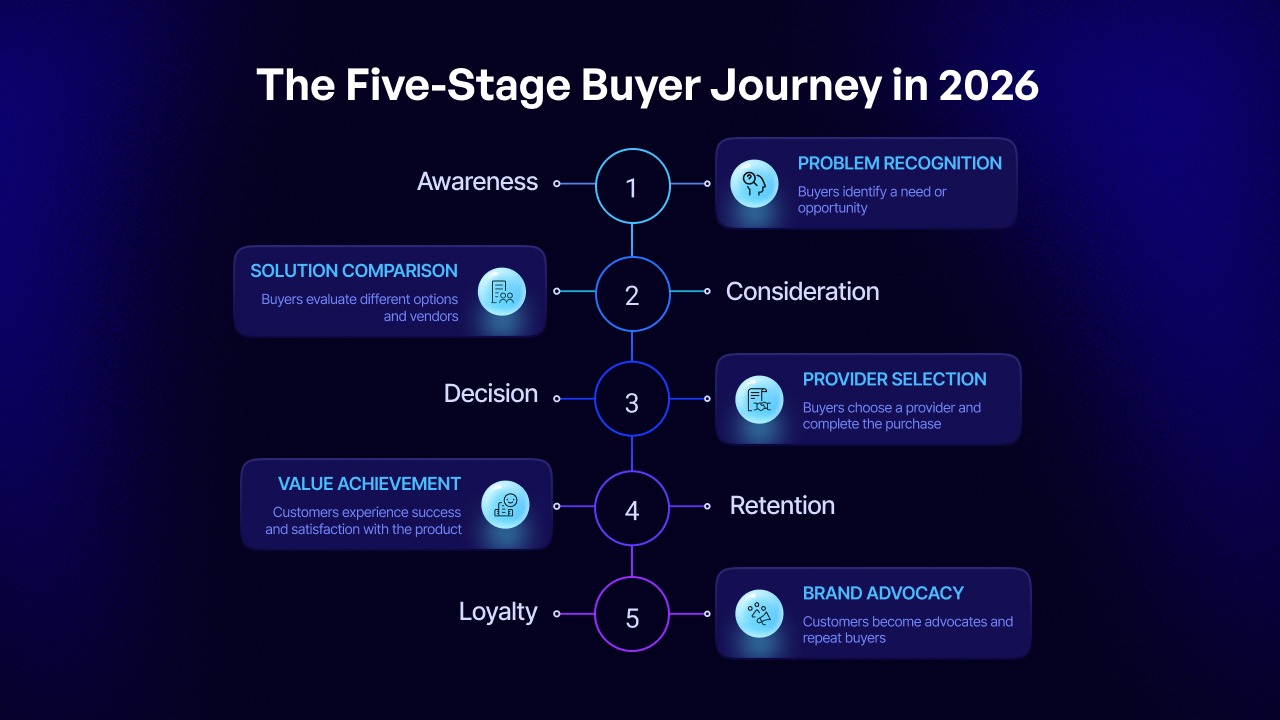
While traditional models include three buyer journey stages: Awareness, Consideration, and Decision, most advanced businesses now use a five-stage model to design a truly effective buyer journey.
| Stage | Core Objective | Primary Psychological State |
| Awareness | Define the problem | Curiosity & exploration |
| Consideration | Compare solutions | Evaluation & validation |
| Decision | Choose provider | Risk assessment |
| Retention | Achieve value | Satisfaction & reinforcement |
| Loyalty | Advocate & repeat | Emotional connection |
The key insight for 2026 is this: buyers do not move in straight lines. They revisit comparison pages after reading reviews. They go back to awareness content even after seeing pricing. They seek reassurance multiple times. Speaking of that, your buyer journey design must accommodate this non-linear behavior.
Stage 1: Awareness — Where Attention Is Earned
At the awareness stage, buyers recognize a problem or opportunity but may not yet know what solution category they need. They are looking for understanding, not products.
This is the stage where your brand can earn authority.
Instead of selling, you should clarify pain points. Educational content that demonstrates empathy performs best. The goal is to become the first helpful resource they encounter.
Effective buyer touchpoints at this stage often include:
- SEO-optimized educational blog articles
- Social media posts that highlight industry challenges
- Thought leadership insights
- Industry statistics and research reports
- Short-form explainer videos
Why this matters for conversion optimization:
When buyers associate your brand with clarity and insight at the awareness stage, they are significantly more likely to consider you later. This early value establishes credibility before competitors even enter the conversation.
In Buyer Journey 2026, AI-powered search summaries mean your content must be structured, well-organized, and authoritative to surface in results.
Stage 2: Consideration — Where Trust Is Built
During the consideration stage, buyers actively evaluate options. They have identified the type of solution they need and are now comparing vendors. Here, messaging must shift from education to differentiation.
Buyers typically want answers to questions like:
- How is this solution different?
- What results can I realistically expect?
- What are the trade-offs?
- What does it cost?
This stage benefits from deeper content formats such as:
- Case studies with measurable results
- Comparison pages (transparent and honest)
- Feature breakdowns
- ROI calculators
- Webinars or product walkthroughs
This stage plays a critical role in marketing funnel optimization because uncertainty peaks here. If your buyer journey touchpoints do not address objections clearly, buyers return to research mode again. That is how they start discovering competitors.
A strong customer experience strategy ensures consistent messaging across the website, email, and sales communication during this stage.
Stage 3: Decision — Eliminating Friction
At the decision stage, buyers are nearly ready to convert. However, friction points in buyer journey design can easily derail momentum.
Friction often appears in subtle forms:
- Too many checkout steps
- Hidden fees revealed late
- Poor mobile optimization
- Lack of trust signals
- Overwhelming feature descriptions
Conversion optimization at this stage is about reducing cognitive load. The path forward should feel simple and safe.
Effective decision-stage enhancements include:
- Clear and transparent pricing
- Prominent testimonials and reviews
- Risk-reversal strategies (money-back guarantees)
- Live chat or instant support
- Simplified checkout flows
An effective buyer journey reassures buyers that they are making the right decision. It removes doubt rather than creating urgency.
Stage 4: Retention — Extending the Journey
Designing an effective buyer journey in 2026 requires thinking beyond the transaction. Retention determines profitability.
Acquiring new customers is often more expensive than retaining existing ones. A well-designed customer retention strategy focuses on helping customers achieve success quickly.
Retention initiatives may include:
- Personalized onboarding sequences
- Educational email series
- Product adoption campaigns
- Usage analytics insights
- Customer support check-ins
The faster customers experience value, the more likely they are to stay. Retention directly impacts:
- Customer lifetime value
- Repeat purchase rate
- Subscription renewal rate
Retention is not an afterthought. It is a continuation of the buyer journey.
Stage 5: Loyalty — The Customer Loyalty Stage
The final stage transforms satisfied buyers into advocates. At the customer loyalty stage, customers move from transactional engagement to emotional alignment with your brand.
This is where referral growth and organic advocacy emerge. Strategies that strengthen loyalty include:
- Referral programs
- Exclusive loyalty rewards
- VIP communities
- Early product access
- Public recognition initiatives
Loyal customers are powerful because they shorten future buyer journeys for new prospects through social proof.
How To Design a Buyer Journey (Step-by-Step Implementation Framework)
Designing an effective buyer journey is not about drawing a funnel diagram. It is about aligning real buyer psychology, behavioral data, and business objectives into one connected system.
Below is a practical implementation framework you can actually execute.
1. Start With Deep Buyer Persona Development
Before mapping stages, you must understand who is moving through them.
Many businesses create surface-level personas (age, job title, income). That is not enough. An effective buyer journey is driven by motivation, urgency, and decision triggers, not demographics alone.
Go beyond “who they are” and focus on:
- Core pain points (functional and emotional)
- Desired outcomes
- Risk tolerance
- Buying objections
- Budget authority
- Decision-making timeline
- Influencers involved in the purchase
For B2B, identify:
- Economic buyer (controls budget)
- Technical buyer (validates feasibility)
- End user (experiences product value)
For B2C, identify:
- Emotional triggers
- Social validation needs
- Lifestyle alignment factors
Action Step:
Use:
- Customer interviews
- Sales team insights
- Website analytics
- Heatmaps
- Survey tools
The stronger your persona clarity, the more precise your buyer journey mapping becomes.
2. Define Clear Buyer Journey Stages Based on Behavior (Not Assumptions)
Instead of copying a generic Awareness → Consideration → Decision model, define stages based on actual behavioral signals in your business.
Ask:
- When do visitors shift from informational browsing to solution comparison?
- What actions indicate buying intent?
- At what point do users engage with pricing?
Map real behavioral triggers such as:
- Reading 2+ educational articles → Awareness
- Downloading comparison guides → Consideration
- Viewing pricing page multiple times → Decision
- Completing onboarding steps → Retention
- Referring others → Loyalty
This data-driven approach ensures your buyer journey reflects reality, not theory.
3. Map Every Buyer Touchpoint Across Channels
Now visualize the entire customer purchase path. A touchpoint is any interaction between a potential buyer and your brand. Many businesses underestimate how many exist.
Common buyer journey touchpoints include:
Owned Channels
- Blog posts
- Landing pages
- Product pages
- Email campaigns
- Webinars
- Live chat
Paid Channels
- Google Ads
- Social media ads
- Influencer collaborations
Earned Channels
- Reviews
- Community mentions
- Referral conversations
Create a simple table to organize them:
| Stage | Touchpoints | Goal |
| Awareness | Blog, SEO, Social posts | Educate & attract |
| Consideration | Case studies, email nurture, demos | Build trust |
| Decision | Pricing page, testimonials, consultation | Convert |
| Retention | Onboarding emails, support docs | Ensure success |
| Loyalty | Referral program, rewards | Encourage advocacy |
This clarity helps identify missing or redundant touchpoints.
4. Identify and Eliminate Friction Points
Even strong traffic and messaging fail if friction exists. Friction points in buyer journey design are moments where uncertainty, confusion, or complexity reduces forward momentum.
Common friction areas:
- Slow page loading speed
- Confusing navigation
- Hidden pricing
- Too many form fields
- Unclear CTA
- Inconsistent messaging
- Weak social proof
To uncover friction:
- Analyze drop-off rates in analytics
- Conduct usability tests
- Review session recordings
- Ask customers why they hesitated
Often, improving friction points increases conversions faster than increasing traffic.
5. Align Content With Buyer Intent at Each Stage
One of the biggest improvements you can make is aligning messaging with buyer psychology. Different stages require different communication styles:
| Awareness Stage | Consideration Stage | Decision Stage | Retention Stage | Loyalty Stage |
| Educational, non-promotional | Comparative, analytical | Reassurng, transparent | Supportive, instructional | Appreciative, exclusive |
| Focus on problem clarity | Highlight differentiation | Address objections | Focus on success metrics | Reward engagement |
| Answer search-based questions | Show real use cases | Emphasize guarantees |
Misalignment (e.g., pushing discounts during awareness) reduces trust and effectiveness.
6. Integrate Sales, Marketing, and Support
An effective buyer journey is cross-functional.
- Marketing attracts.
- Sales converts.
- Support remains.
But if messaging differs across departments, buyers feel inconsistency.
Ensure alignment on:
- Value propositions
- Target persona definitions
- Objection handling
- Customer success metrics
Create internal documentation that outlines:
- Key stage messaging
- Core differentiators
- Approved positioning statements
Consistency improves trust and strengthens your overall customer experience strategy.
7. Implement Measurement and Continuous Optimization
A buyer journey is never “finished.” It evolves with buyer behavior, competition, and technology. Track stage-specific metrics:
Awareness
- Organic traffic growth
- Time on page
- Bounce rate
Consideration
- Lead magnet downloads
- Email engagement
- Demo requests
Decision
- Conversion rate
- Cart abandonment rate
- Sales cycle length
Retention
- Churn rate
- Product usage rate
- Repeat purchase frequency
Loyalty
- Referral rate
- Net Promoter Score (NPS)
- Customer lifetime value
Use A/B testing to refine:
- Headlines
- CTA placement
- Pricing presentation
- Onboarding sequences
Optimization ensures your buyer journey stays effective as behavior shifts.
Common Mistakes to Avoid for an Effective Buyer Journey
Even well-intentioned businesses undermine their buyer journey through avoidable errors. Below are the most impactful ones.
1. Treating the Buyer Journey as Linear
One of the most common mistakes in buyer journey design is assuming that customers move in a straight line from awareness to purchase. Modern buyers rarely follow a linear path. They often research a problem, compare solutions, and then return to research again.
Similarly, they might add a product to their cart, leave the website, read reviews, and revisit the decision later. Treating the journey as a straight path can lead to weak follow-up strategies and ineffective retargeting campaigns.
To address this, businesses should use remarketing to stay visible to returning prospects, provide layered content that meets buyers wherever they are in their journey, and anticipate re-evaluation behavior by offering helpful, trust-building information at multiple touchpoints. This approach ensures that the buyer journey reflects real-world behavior and improves the chances of conversion.
2. Over-Prioritizing Acquisition and Ignoring Retention
Another common pitfall is focusing too heavily on acquiring new customers while neglecting retention. Many companies pour resources into driving traffic and generating leads, but without a strategy to keep existing customers engaged, this approach leads to high acquisition costs, low customer lifetime value, and revenue instability.
In fact, retention strategies often deliver a stronger return on investment than constantly acquiring new customers. To avoid this mistake, businesses should invest in effective onboarding systems that help customers achieve value quickly, monitor churn indicators to identify at-risk users early, and implement programs that reward repeat customers.
By balancing acquisition with retention, companies not only secure immediate sales but also build long-term, sustainable growth.
3. Creating Content Without Intent Mapping
Publishing content without clearly mapping it to specific buyer journey stages can create inconsistency and reduce overall effectiveness. Signs that this is happening include high website traffic with low conversions, strong engagement on content but weak sales, and email sequences that fail to resonate with recipients.
Every piece of content should have a clearly defined stage in the buyer journey, a specific objective that aligns with buyer intent, and a measurable KPI to track performance. By intentionally linking content to each stage—whether awareness, consideration, decision, retention, or loyalty—you ensure that every interaction moves the buyer closer to conversion and strengthens the overall customer experience strategy.
4. Ignoring Emotional Drivers
Buying decisions are rarely driven by logic alone; emotions play a crucial role in influencing choice. Common emotional drivers include the fear of making the wrong decision, the desire for status, the need for security, and the influence of peer validation.
Ignoring these emotional triggers can significantly weaken your persuasive power and reduce conversions. To strengthen the emotional appeal of your buyer journey, incorporate storytelling that resonates with your audience, highlight the transformative outcomes your product or service delivers, and showcase real customer success stories.
By connecting with buyers on an emotional level, you not only build trust but also increase the likelihood that prospects will move confidently toward a purchase.
5. Lack of Cross-Team Communication
When marketing promises one outcome but support delivers a different experience, trust with your customers can quickly erode. This misalignment often results in high refund rates, negative reviews, and customer confusion, all of which damage brand credibility.
To prevent these issues, organizations should hold regular cross-team alignment meetings to ensure marketing, sales, and support are on the same page. Sharing customer feedback internally helps teams understand pain points and adjust messaging or processes accordingly.
Additionally, standardizing messaging frameworks across departments ensures that every customer interaction reinforces the same value proposition, creating a cohesive experience that builds trust and loyalty throughout the buyer journey.
6. Failing to Adapt to Buyer Journey 2026 Trends
Buyer behavior is evolving at an unprecedented pace. Modern buyers are increasingly using AI tools to research products, comparing more options than ever before, expecting personalized experiences, and relying heavily on reviews and social proof before making decisions. If your buyer journey strategy remains static or outdated, your marketing performance and conversion rates are likely to decline. To stay ahead, businesses must remain adaptable.
This means regularly monitoring behavioral data on a quarterly basis, testing new content formats to see what resonates, reviewing competitor positioning to understand emerging trends, and updating buyer personas annually to reflect shifting motivations and preferences.
By continuously aligning your strategy with the changing needs of your audience, you ensure that your buyer journey remains effective and relevant in a fast-moving digital landscape.
Guide the Journey, Win the Buyer
The modern buyer journey is complex, non-linear, and driven by informed decision-making. Brands that guide prospects thoughtfully at each stage, from awareness to consideration, decision, retention, and loyalty, gain a competitive advantage.
By reducing friction, aligning messaging with intent, and leveraging personalization, you turn uncertainty into confidence. When done right, the buyer journey is no longer just a roadmap for sales; it becomes a strategic engine that builds trust, strengthens relationships, and creates advocates who fuel your growth organically.
Have you found this blog useful? Share your thoughts in the comments section and subscribe to our newsletter or join our community to receive additional fundraising tips and tricks.